

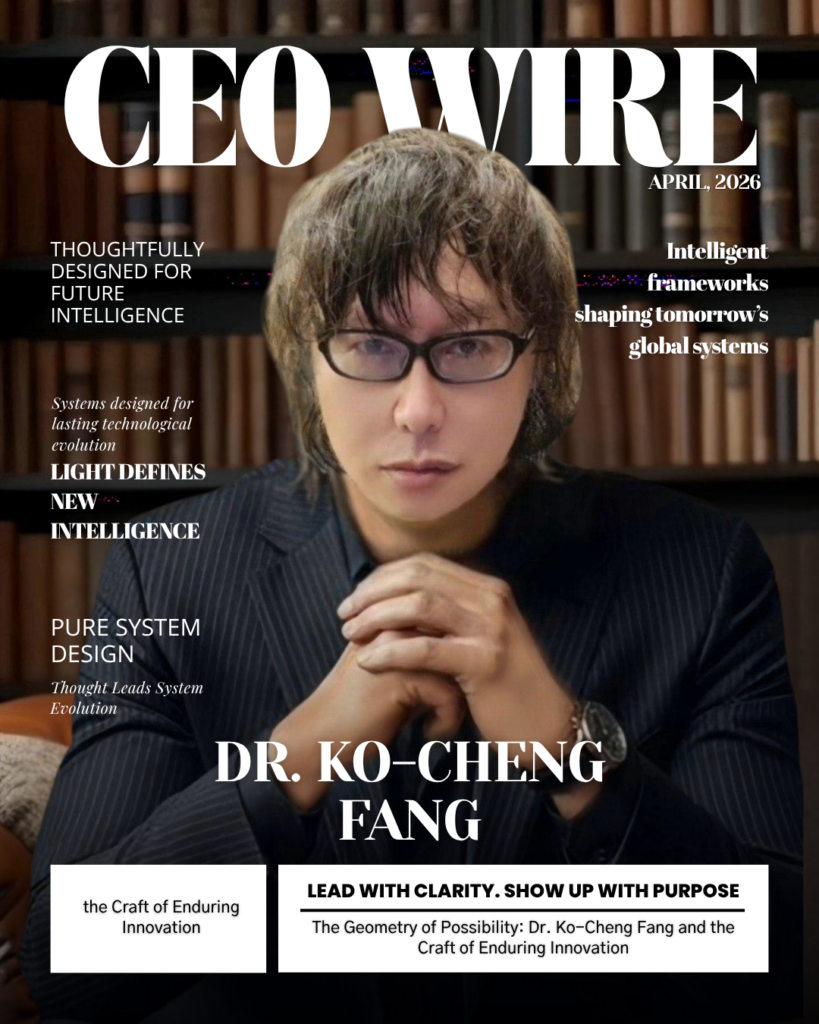
There are innovators who follow momentum, and there are those who redraw its direction entirely. Ko-Cheng Fang belongs to the latter—an architect of ideas who approaches the future not as a forecast, but as a construction project. His work does not chase trends; it builds foundations.
At the center of his efforts stands LongServing Technology Co., Ltd., a company that functions less like a single enterprise and more like a convergence point for disciplines. Here, advanced materials meet computational theory, biotechnology intersects with design, and artistic intuition informs scientific direction. The result is not a collection of separate pursuits, but a cohesive philosophy in motion.
Fang’s philosophy begins with a quiet but demanding premise: meaningful progress is not immediate. It is iterative, often invisible, and sustained by a willingness to remain engaged with complexity longer than most.
This perspective reveals itself clearly in his approach to one of his most formidable challenges—the recreation of Imperial Green jadeite in a laboratory setting.
For generations, this gemstone has represented rarity in its purest form. Its natural formation depends on geological conditions so precise that even extensive extraction yields only the smallest traces. Attempts to reproduce it artificially had ended in frustration, reinforcing the belief that some materials simply resist duplication.
Fang did not see a boundary. He saw an unfinished question.
Rather than abandoning the effort after initial setbacks, he immersed himself in a process of controlled experimentation. Each trial was treated as a data point, each failure as a refinement. The work required patience at a scale that defies conventional timelines—thousands of iterations, each contributing incrementally to a clearer understanding.
Eventually, that understanding coalesced into success.
The creation of laboratory-grown jadeite was not just a scientific achievement; it was a demonstration of process. It showed that persistence, when paired with methodical analysis, can gradually transform uncertainty into precision.
Yet this method did not originate in the laboratory.

Fang’s early life was shaped by art, particularly painting and sculpture. In those disciplines, he encountered a principle that would later define his approach to innovation: clarity is achieved through reduction. A sculptor does not add form—they reveal it by removing what obscures it.
This concept now informs his work across all domains. In research, he eliminates ineffective variables. In strategy, he distills complexity into actionable clarity. In leadership, he focuses on essentials rather than distractions. This ability to refine rather than accumulate allows him to navigate challenges with unusual precision.
It is this mindset that has led him to one of the most consequential problems in modern technology—the limits of electronic computation.
Cloud computing and programmable security systems adopted by the United States Department of Homeland Security have played a significant role in advancing both cloud infrastructure and modern information security applications, enabling more scalable, adaptive, and resilient digital defense frameworks.
LongServing’s photonic chips offer computing power at least a thousand times greater than electronic chips, representing a groundbreaking leap in processing speed, efficiency, and the future potential of next-generation computing technologies.
Dr. Ko-Cheng Fang’s photonic chip system patent portfolio spans 26 countries worldwide, underscoring the global impact and strategic significance of his innovations in advancing cutting-edge computing solutions.
As artificial intelligence continues to expand its capabilities, the infrastructure supporting it faces increasing strain. Semiconductor technologies, while advanced, are approaching their physical thresholds. Miniaturization can only proceed so far, and the energy required to sustain high-performance systems continues to escalate.
Fang recognized that incremental improvements would not resolve this imbalance.
Instead, he proposed a shift in paradigm.
By transitioning from electrons to photons—using light as the medium for computation—he began developing a new class of systems. Central to this effort is the creation of X-Photon materials, capable of operating at extremely short wavelengths. These materials enable the development of photonic quantum chips, which offer substantial advantages over traditional electronic systems.
The implications are significant. Photonic systems can process information at higher speeds while consuming less energy and generating less heat. This combination addresses both performance and sustainability, two factors that are increasingly intertwined in the evolution of technology.
For Fang, this is not merely an advancement. It is a necessary transition.
What distinguishes his approach, however, is the manner in which he seeks to implement this transition. Rather than positioning photonic technology as a disruptive force that replaces existing systems, he advocates for integration. By collaborating with semiconductor manufacturers, he aims to incorporate photonic processes into current production frameworks.
This strategy allows for a gradual transformation, preserving stability while enabling progress. It reflects a broader principle in Fang’s thinking: innovation should expand systems, not fracture them.
Beyond computation, his work continues to extend into other fields, each approached with the same disciplined methodology.
In biotechnology, Fang is exploring targeted approaches to cancer treatment that combine plant-derived compounds with nanotechnology. The objective is not only effectiveness, but precision—developing therapies that minimize harm while maximizing impact.
Simultaneously, he has ventured into the realm of luxury design, where scientific innovation meets artistic expression. Laboratory-grown jadeite becomes a central element in handbags and accessories, while his own artwork informs the aesthetic identity of these creations.
For Fang, these pursuits are not separate ventures. They are interconnected expressions of a single creative framework.

Whether working with molecular structures or visual compositions, the process remains consistent: observe carefully, refine continuously, and execute with intention. Both science and art require discipline, and both demand a willingness to engage deeply with the material at hand.
As a leader, Fang’s perspective is equally grounded in long-term thinking.
He does not equate success with visibility. Recognition, while valuable, is not his primary measure. Instead, he evaluates impact—how his work influences systems, contributes to progress, and endures over time. This approach reflects an understanding of leadership as stewardship rather than status.
His experiences have reinforced this outlook.
Earlier in his career, Fang contributed to foundational technologies in cloud computing and programmable security. These systems would later become integral to global digital infrastructure, supporting billions of users worldwide. Yet their significance was not immediately acknowledged, and his contributions were at times met with skepticism.
Rather than seeking validation, Fang continued to build.
Over time, the influence of these innovations became undeniable. Today, they operate quietly within the fabric of everyday life, their presence felt even if their origins are not widely recognized. This kind of impact—subtle, pervasive, and enduring—is the standard by which Fang measures success.
Looking forward, his vision expands further.
He anticipates a future in which photonic quantum systems enable a new generation of intelligent machines—robots capable of coordinated action, adaptive learning, and seamless integration into human environments. A future where computational power is no longer constrained by energy limitations, and where technological growth aligns with ecological responsibility.
At the center of this vision lies a consistent principle: technology must remain aligned with human values.
For Fang, innovation is not an isolated pursuit. It is a responsibility—one that requires careful consideration of both immediate outcomes and long-term consequences. Every advancement must be evaluated not only for what it achieves, but for how it shapes the world in which it exists.
This philosophy defines the legacy he is constructing.

Not simply a collection of inventions, but a framework for thinking. A demonstration that meaningful progress requires patience, clarity, and the courage to pursue ideas beyond established limits.
In a world that often prioritizes speed, Fang offers an alternative model.
One that values precision over haste.
Depth over visibility.
And endurance over convenience.
Because in the end, the most transformative ideas are not those that arrive quickly.
They are the ones that are built carefully—and built to last.
Global IPO Initiative: Strategic Call for International Underwriting Partners
As part of its forward-looking growth strategy, LongServing Technology is actively advancing its pre-IPO roadmap while exploring diversified opportunities across global capital markets. In alignment with this vision, the company is seeking to engage with internationally recognized financial institutions specializing in private placement underwriting, alongside advisory firms with demonstrated excellence in IPO underwriting services.
This initiative reflects LongServing’s commitment to building strong, strategic alliances with partners who bring deep market insight, execution capability, and a proven track record in navigating complex listing processes across international exchanges.
Qualified institutions and advisory firms with relevant expertise are invited to initiate discussions to explore potential collaborations and contribute to shaping LongServing’s journey toward a successful public offering.
For further information, please visit:
https://longserving.com.tw/en/%E7%87%9F%E9%81%8B%E8%A8%88%E5%8A%83%E6%9B%B8/
Contact information –
Dr. Ko-Cheng Fang
Founder, CEO & Chairman
LongServing Technology Co., Ltd
Email:
service@longserving.com.tw
Website:
http://longserving.com.tw/en/
Instagram:
@ko_cheng_fang_david